01
Apply with decision metadata
Describe the decision, accountable owner, consequence, timing, and evidence categories. Do not send sensitive source material through public intake.
Bring one consequential decision for a scoped commercial review. Fees are quoted individually; scope, deliverables, timing, and price are agreed in writing before work begins. Sending an inquiry creates no engagement or payment obligation.
We examine applicable governance, evidence, unresolved conditions, and rightful Human Authority. The bounded review produces a documented decision basis and disposition within its agreed scope—not a guarantee of decision correctness.
Email inquiries for Michael Handy: aegis@circulardeduction.com
Opens your email app. You can also copy the address into any mail service.
Do not send confidential, regulated, proprietary, privileged, or client-controlled information through ordinary email. A separate authorized channel can be established when appropriate.
Looking for the separate evidence program? Review Founding Decision Review eligibility — no-charge during Phase 1, application-only, subject to fit and capacity.
Commercial path
Commercial work covers Decision Review, Project & Program Decision Review, Governance Translation, and Decision Governance Design. Each engagement has an agreed scope, outputs, responsibilities, and fee; there is no required purchase sequence.
Quoted by scope. Examine one consequential decision and receive a Decision Basis Record covering evidence, contradictions, authority conditions, and reconsideration triggers.
Quoted by scope. Examine connected investment, vendor, scope, or delivery decisions, with records of dependencies, accountable owners, and escalation conditions.
Quoted by scope. Translate named policies, standards, and contractual requirements into controls and evidence requirements, with versioned traceability and unresolved interpretations visible.
Quoted by scope. Define roles, review gates, exception paths, and reconsideration triggers for a bounded decision workflow, with acceptance-test specifications.
The limited Founding Decision Review, when offered, is a separate evidence program and is not the commercial Decision Review. Commercial scope and price are confirmed before work begins.

The Founding Decision Review is a separate, application-only evidence program. Commercial services are independently scoped and quoted; participation in this program is not a prerequisite.
Describe the decision, accountable owner, consequence, timing, and evidence categories. Do not send sensitive source material through public intake.
We establish materiality, scope, applicable governing sources, Human Authority, evidence needs, handling requirements, and whether the decision is sufficiently pre-commitment. Conflicting or unresolved governance remains visible rather than being silently normalized.
The accountable owner participates while evidence and contradictions are examined. The rightful Human Authority records the disposition, conditions and next actions; participation does not itself authorize commitment.
Completed cases receive a Decision Basis Snapshot and scheduled follow-up; the pre-registered subset receives a full Decision Basis Record.
Separate from the commercial Decision Review, Circular Deduction is opening a deliberately small number of no-charge Founding Decision Reviews to expand the external evidence base for the method. Participation is application-only and limited to consequential organizational decisions with an identifiable accountable decision owner.
The decision must still be meaningfully pre-commitment, sufficiently bounded, and consequential beyond the applicant alone. We ask what happens if it is made badly and who else is materially affected.
Accepted participants prepare the case, participate directly in the full review, agree to a controlled evidence-capture path, and schedule a follow-up before the review begins.
Frame → Derive → Contradict → Reconcile → Commit → Extract → Reinsert. Every completed case receives a Decision Basis Snapshot; a pre-registered subset receives a full Decision Basis Record. Reinsertion is recorded as an authorized change or an explicit disposition.
Phase 1 evaluates method behavior, decision-basis change, Human Authority, artifact usefulness, repeatability, and follow-up. It does not test willingness to pay, pricing, commercial demand, or guarantee decision outcomes.
Public intake is decision metadata only. Do not send attachments or confidential, privileged, regulated, proprietary, Tribal/confidential, customer-controlled, export-controlled, health, financial-account, credential, or security-sensitive information. Accepted participants receive separate participation and evidence-use terms before evidence is shared.
Consequential Decision Review
A Decision Review examines what supports the decision, which governing requirements apply, what conflicts, who may act, how completion will be verified, and what would reopen it.
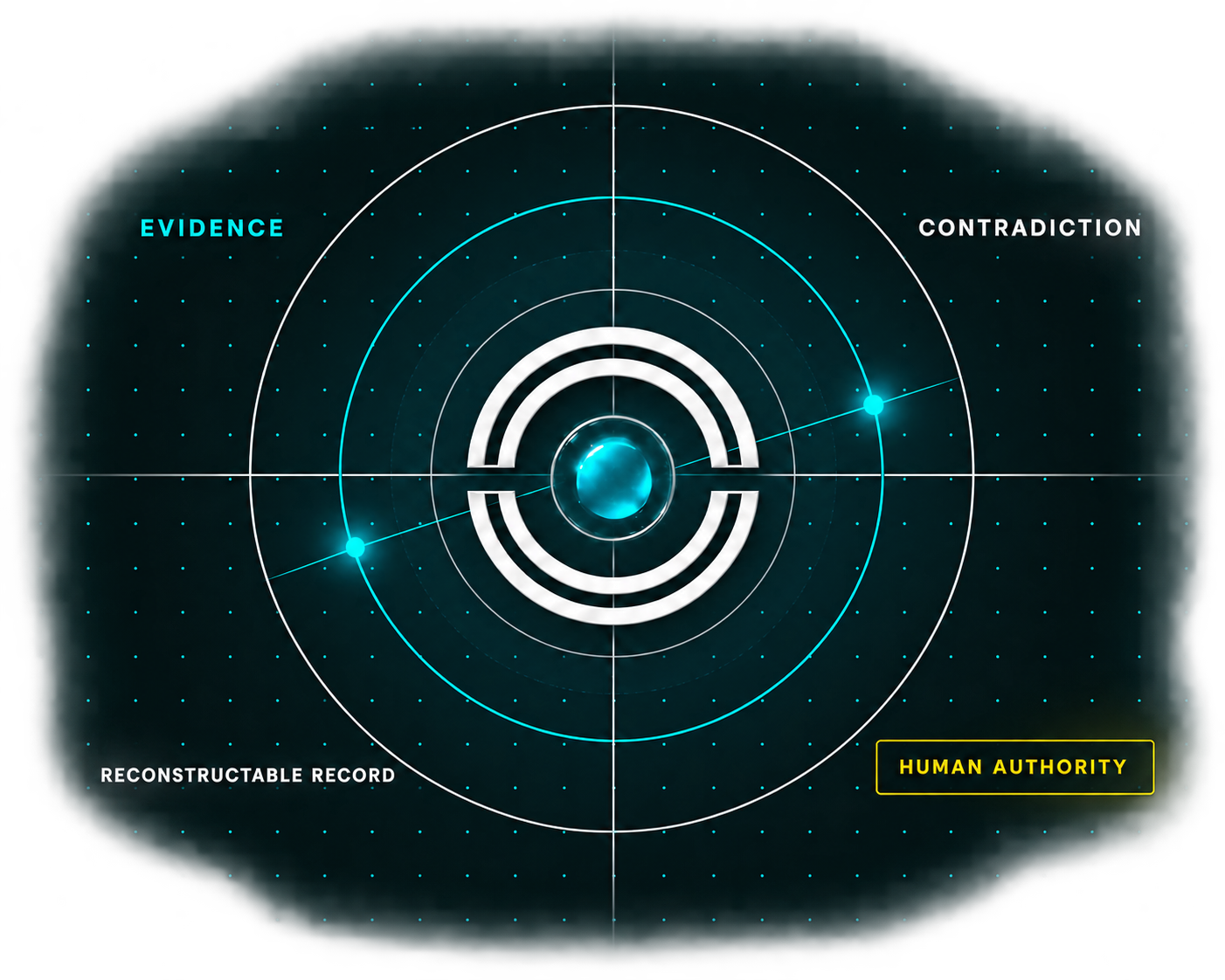
Evidence, contradiction, authority, commitment, and the record of change remain explicit. This is decision governance—not a claim of standards certification, regulatory compliance, or guaranteed outcomes.
The artifact set depends on agreed scope and evidence availability. Outputs describe the decision basis, commitments, verification requirements, and limitations; they do not guarantee outcomes. Software components remain under controlled development.
A clear statement of what is being decided, by whom, and under what constraints.
A visible record of support, conflict, assumptions, and unresolved material gaps.
A bounded view of who may recommend, decide, execute, verify, accept residual risk, and authorize closure.
A concise recommendation with conditions, limitations, and what would change it.
A reconstructable record of evidence, authority, commitments, intended and observed states, verification, residual risk, and current disposition.
Defined conditions for reopening a decision when new evidence, failed verification, recurrence, or changed circumstances challenge its basis.
Circular Deduction LLC is the business party for proposed engagements. Michael Handy, Founder and Method Owner, is the accountable Human Authority and primary contact for fit, scope, and commitment.
The first step is to confirm fit; scope, deliverables, fees, and timing are agreed in writing before work begins.
Commercial entry · bounded by design
Define the decision or workflow, evidence needs, accountable owner, intended outputs, and completion criteria. A Diagnostic is an optional delivery format when the problem needs further definition.
Scoped commercial basis
Scope first. Terms second.
Fees reflect decision scope, evidence workload, governance complexity, and delivery requirements. Scope, exclusions, timing, and price are agreed in writing. The examples below describe Decision Review outputs; other services have their own agreed deliverables.
Request scoped termsOpens your email app. Or write to aegis@circulardeduction.com with a brief, non-confidential summary.
Follow one public-safe decision through evidence, contradiction, reconciliation, Human Authority, commitment, and a reconstructable record.